How an oil shock moves your mortgage rate.
The Strait of Hormuz carries roughly 1/5 of the world's oil. When Iran restricted transit in early March 2026, crude quickly surged from $70/barrel (on February 27, the day before the conflict started) up to US$100/barrel — the largest supply disruption in the history of the global oil market, according to the IEA (International Energy Agency).
But it's not just crude. Fertilizers, LNG, and industrial commodities that move through the Strait have all been disrupted. Energy is an input to nearly everything, and when it spikes, higher costs can spread quickly and broadly across the economy.
Gasoline and heating fuel hit consumers directly and usually immediately, as we first saw at the gas pump and in airline ticket prices. Higher diesel raises the cost of moving virtually all goods. Natural gas price increases push up fertilizer costs, which quickly feed into food prices — oil has historically influenced as much as 64% of food price movements, according to World Bank research.
Energy-intensive manufacturing (aluminum, glass, steel, chemicals) also sees immediate increases in input costs that cascade through supply chains, with U.S. research suggesting that about 70% of those costs are eventually passed on to consumers.
For mortgage rates, the critical influence is inflation expectations.
When investors expect higher inflation, they demand higher bond yields to protect their purchasing power. Fixed mortgage rates are priced off Government of Canada bond yields — and when yields rise, fixed rates follow within days (usually first seen in the 5-year rate, the standard term). That's exactly what happened this time: bond yields jumped from 2.7% to above 3%, and lenders repriced 5-year fixed rates shortly afterwards.
When bond yields rise in response to concerning market factors, it can be a sign that bond traders expect central banks to raise their benchmark interest rates to slow demand and curb inflation, which in turn raises prime and variable bank rates, impacting mortgages and HELOCs.
Yet, an oil shock usually slows the economy.
What an oil spike really does is add a tax on consumers and businesses. Every extra dollar spent on gas or groceries is a dollar not spent on restaurants, retail, travel, or renovations. That pullback in discretionary spending is disinflationary — and in an economy already losing momentum, it might not take much to push it over the edge.
In response to ongoing U.S. trade issues, Canada's GDP is barely holding above the recessionary threshold so far in 2026, amid a softening labour market and an elevated unemployment rate. Housing has stalled. Business investment is gloomy. The economy may not have the momentum to sustain a broad inflationary cycle — so it stands to reason that higher costs are more likely to depress demand than ignite a wage-price spiral.
Doesn't Canada benefit from higher crude prices? Unlike most oil-importing countries, Canada does benefit partly from higher crude prices through exports. Vanguard's scenario analysis shows that higher oil prices actually lift Canadian GDP across all three of its conflict scenarios.
It may be enough to keep Canada out of a recession, but not enough for consumers to overlook higher prices. RBC recently concluded that the oil spike is unlikely to revive broad-based inflation or shift the Bank of Canada's rate path toward a rate increase to curb it.
Has the Iran conflict already affected mortgage rates?
Yes. The war in Iran drove up 5-year fixed rates by about 0.40%. Once the conflict restricted oil transit through the Strait of Hormuz, bond yields rose quickly as investors priced in inflation risk (fixed rates are correlated with bond yield movements). Lenders repriced their fixed-rate products almost immediately.
Variable rates have not moved because they follow the Bank of Canada's overnight rate, rather than the bond market. The BoC has held the policy rate at 2.25% across the past 3 decisions, and the best advertised variable rate is currently around 3.6% (after lender discount off prime). But that could change — markets are currently pricing in a possible rate hike or two by year-end if inflation rises too fast.
Could fixed rates rise further from here?
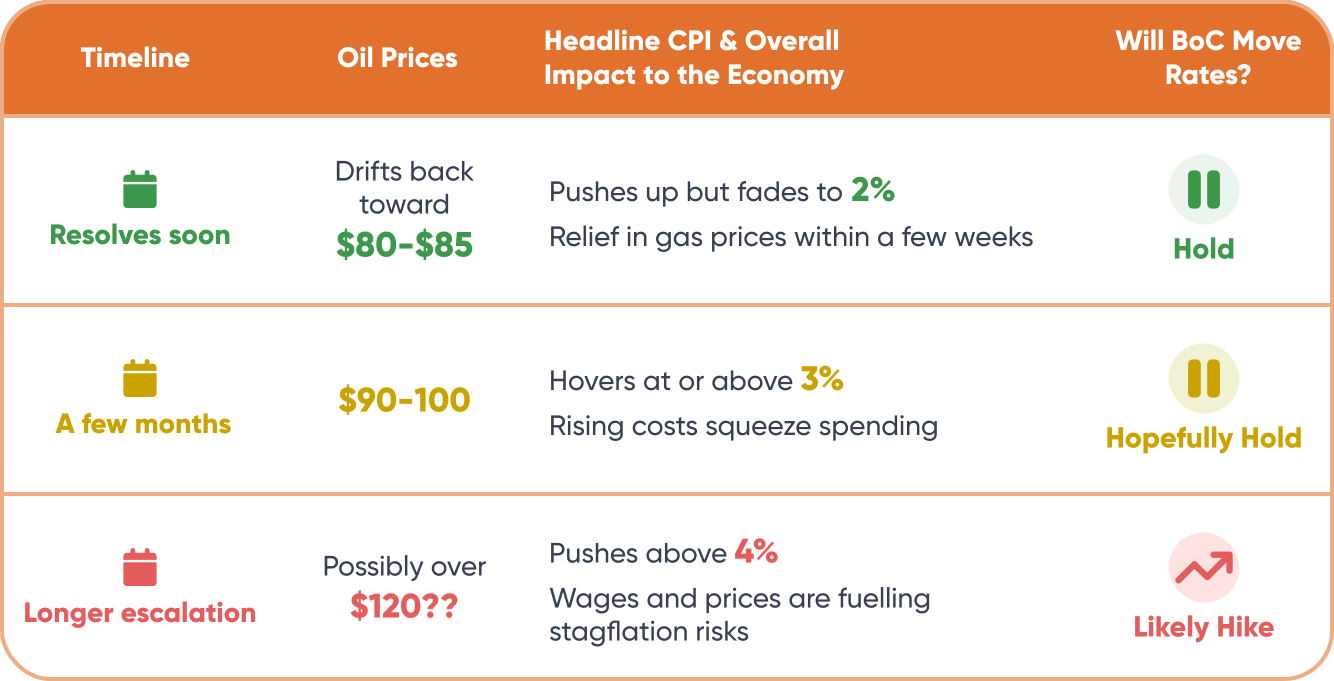
They could, but we think most of the upward move may be behind us. Most forecasters expect yields to trade in a relatively narrow range from here unless the conflict escalates or continues longer than expected. A further modest uptick is possible, but another yield surge would likely require oil at $120+ or amid indications of an aggressive BoC tightening cycle to tame inflation.
Watch the 5-year bond yield — it's the leading fixed rate indicator. If yields remain around 3.0–3.1%, fixed rates hold roughly where they are. A sustained move above 3.2–3.5% would signal more pressure, which we would note in our Rate Forecast blog.
Could the BoC raise rates to fight inflation?
Markets and some economists think it's a real possibility, but not necessarily the reality. Bank of Canada Governor Macklem acknowledged the dilemma directly in the March 18 decision, but also that raising its policy rate (which raises bank prime rates) to fight inflation could further weaken the economy, while easing rates to support growth could push inflation above target.
Macklem's stated approach is to "look through the war's immediate inflation impact," provided it remains temporary and doesn't broaden into other spending categories. Most of the Big Six banks expect a continued policy rate hold at 2.25% through 2026. However, both CIBC and Scotiabank forecast a 0.75% hike (up from a previous forecast of 0.50%), and IG Wealth Management believes a cut remains possible if the numbers continue to show softening.
What do we think at True North Mortgage? The economy may be too weak for the BoC to hike comfortably, and a rate hold through 2026 is the more likely outcome. But if oil stays elevated for months and inflation expectations start to unmoor, it could force the Bank's hand — the institution's sole mandate is to hold headline inflation at its 2.0% target.
What rate should you choose amid this oil-price uncertainty?
Our clients are choosing variable over fixed at roughly a 2-to-1 ratio — and that's less to do with the uncertainty around the Iran conflict and more with trying to save more on their mortgage, as fixed rates are currently higher. Most borrowers can convert to a fixed rate later without penalty if they become uncomfortable with the variable-rate risk of change.
Or, those homebuyers or owners seeking greater budget certainty are leaning toward shorter fixed terms (2–3 years) rather than a 5-year lock. The logic is that if the disruption resolves and inflation moderates, they renew into better rates sooner. If it doesn't, they've bought themselves known payments through an uncertain period.
For a deeper comparison between these two rate types, see Should You Choose a Variable Rate in 2026?
How long could this last? Even a ceasefire doesn't mean it's over.
A temporary or permanent end to hostilities in the Strait of Hormuz and related areas does not necessarily mean this economic conundrum is over.
For example, despite a ceasefire declared on April 8, hundreds of tankers remain stuck in the Gulf, transit is selective and inconsistent, ships are still making U-turns at Larak Island, and the U.S. (and now Iran) have declared a naval blockade on ships entering or leaving Iranian ports. Maritime intelligence reports describe access as dependent on permissions, not open navigation.
The tension and complexity could remain for weeks or months, even if primary hostilities cease, which could continue to impact global oil supply.
Even a full peace agreement wouldn't flip a switch. Clearing tanker backlogs, restoring war-risk insurance to normal premiums, re-establishing shipping confidence, and physically moving the stranded crude could take weeks to months.
Energy markets will price according to these lags.