This type of variable-rate mortgage has payments that adjust with movements in the prime rate.
It differs from a variable-rate mortgage you get with a big bank (a VRM), which has fixed payments despite a variable rate. Learn the important differences between these two variable types — and why one may end up costing you a lot more.
Jun 11, 2026
Updated from Nov. 4, 2023
Share this content
Or Copy this link
Are you a THINK Financial client? Then you have an ARM with floating payments. A VRM with fixed payments are offered by most big banks.
Variable Rate? Adjusting vs. Fixed Payments
Some homeowners choose a variable rate, despite the risk of changes in the prime rate, to potentially save more than they would with (typically) higher fixed rates.
But there are two types of variable-rate mortgages, and the payment type you choose can affect the overall variable-rate savings advantage.
An adjustable-rate mortgage (ARM) keeps your mortgage finances on track, even though your monthly payment (and budget) may shift.
However, if you have a fixed-payment variable-rate mortgage (a VRM with a big bank), more or less of your payment goes to interest, which can shrink or grow your amortization — potentially impacting how much interest you pay over your mortgage timeline.
Key Points:
ARM: Adjusting payments that change with prime.
VRM: Fixed payments, but your amortization can shrink or grow with prime rate changes.
Trigger rate: If rates rise too far, a VRM balance can grow faster.
Payment shock:A longer amortization or higher balance can mean a much bigger payment at VRM renewal.
Break penalty: Both carry a 3-month interest penalty — much lower than breaking a fixed rate.
Mortgage goals:An ARM is a better choice for staying on track and potentially saving more.
There are two types of variable-rate mortgages:
An Adjustable-Rate Mortgage (ARM) has a floating payment amount that rises and falls with changes in the prime rate. If the interest rate moves, the full payment change is usually reflected after the upcoming payment (once a full month with the rate change has passed).
A Variable-Rate Mortgage (VRM) hasfixed payments like a fixed-rate mortgage, but the interest portion of your payment rises and falls with changes in prime, pushing your 'principal' portion up or down, and therefore, your amortization up or down.
If you hit your contract trigger rate, the payment no longer covers the interest portion, and your mortgage balance can grow rapidly — though your mortgage finances can be thrown off track before that point.
The main differences between the ARM and VRM products are:
Adjustable-Rate Mortgage (ARM)
Variable-Rate Mortgage (VRM)
Payment Amount Changes with Prime
Yes
No
Interest and Principal
Interest amount changes, principal amount paid stays on track
Within payment amount, interest goes up or down affecting amount going to principal
Mortgage Length (Amortization)
Unaffected by interest changes
Gets longer or shorter depending on the amounts going to principal
Comes with a Trigger Rate/Point
No
Yes; if hit, mortgage length and balance can increase faster
Renewal Risk?*
No. Mortgage length and balance on track to be paid off as scheduled
Yes. If mortgage length and balance have increased, you'll pay a much higher payment (or a lump sum)
HOW YOU SAVE MORE**
If rates go up, mortgage length and balance stay on track and won't cost you more; if rates go down, you'll have extra monthly budget room
If rates go down, more will go to your principal to pay off your mortgage faster
THE POTENTIAL COST
If rates go up, higher payments may STRAIN your budget capacity
If rates go up, you may experience 'payment shock' at renewal, and pay MORE interest over your term if your mortgage length or balance has increased
*Excluding the market rate at renewal
**Beyond typical variable-rate advantages
Can variable-rate fixed payments derail your mortgage goals?
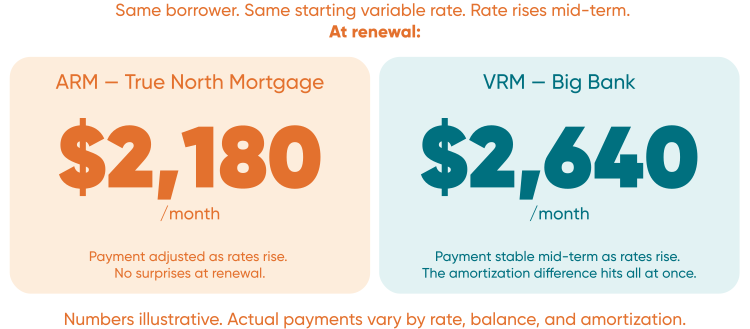
Yes, a VRM risks derailing your mortgage goals. TheVRM product's fixed payments can provide budget certainty. But the higher the rate goes, the more interest you pay, with less going towards your principal. That lengthens your amortization, which can quickly extend beyond your original loan time — a state called negative amortization.
If rates go up and stay up during your term, that negative amortization means you may be in for payment shock when it's time to renew. The above example shows how much higher your renewed mortgage payment might be — in this case, about $460 per month more — just because you have fixed vs. adjustable payments.
Of course, if rates go back down during the same term, the amortization may have enough time to recover by your renewal date.
What is payment shock?
It means renewing into a much higher payment than before, which can occur due to a higher market rate or a suddenly higher mortgage balance. If your amortization has increased during your term, your bank will adjust it to the correct amount when you renew your mortgage (the original term minus previous terms served) — which increases the balance to be paid off over your mortgage lifetime, resulting in a higher monthly payment.
What happens if you hit your trigger rate?
If rates rise enough to hit and surpass your trigger rate and trigger point, both your amortization and mortgage balance will continue to increase. In these cases, the lender will likely contact you to increase your payment or require a lump-sum payment well before your renewal, though it may not be enough to prevent your amortization from increasing.
The ARM may offer better long-term savings.
Better overall?
Many in the mortgage industry, including True North Mortgage CEO Dan Eisner, feel that the ARM's floating payment is a better choiceIF you can handle the potential for increasing payments.
That's why it's the only variable-rate product offered by our in-house lender, THINK Financial.Dan looks at the bigger (mortgage) picture:
"When rates go up, your payments are increasing gradually, allowing some time to adjust, versus the potential 'big payment shock' that may await you at renewal time with the VRM product.
Plus, you're more likely to keep your variable-rate savings intact, without the risk of increasing your interest costs through the fixed-payment vehicle."
Better for your budget if variable rates go down.
With floating payments, if and when variable rates finally start to drop, your payments will adjust downward with each decline, resulting in a lower mortgage payment and some welcome budget relief.
With fixed payments, you likely won't be able to change your payment amount with the lender. And even if variable rates have dropped — if you still have negative amortization by the time you renew, you'll face higher payments.
Your variable mortgage means you'll pay a lower penalty if you need to break.
Compared to a fixed-rate mortgage, a variable-rate mortgage — both the ARM and VRM — offer significantly lower penalties for switching to a different product or lender. You'll pay 3 months' interest vs IRD calculations, which is sometimes the deciding factor that tips a homeowner into a variable-rate product.
Have questions about your variable rate product?
It's important to know which type of variable product you have, or which one is the right choice for you. We have access to several lenders AND products, including those offered through our own lender, THINK Financial. Talk to us today if you have questions!
We're always here to run the numbers for you and provide options if you'd like a change, or if you need more ideas on how to save on your mortgage.
At True North Mortgage, our highly trained brokers have the tools and experience to help you make the right choice for your budget. Give us a shout anywhere you are in Canada — for 5-star mortgage advice.