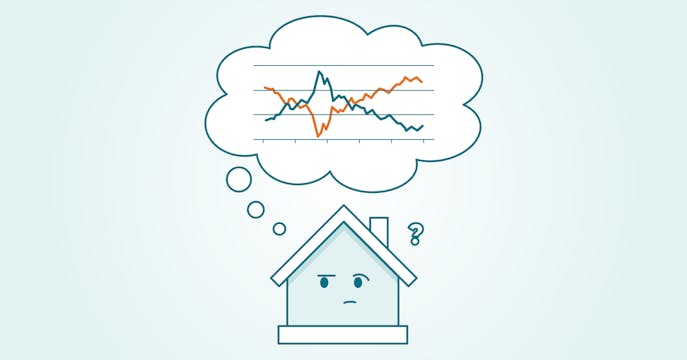
Higher fixed rates will keep variable rates from falling.
Two economic forces — trade drag and elevated inflation risk — are working against each other for rate direction.
Despite being driven by different mechanisms, fixed and variable rates generally move in the same direction. Fixed rates go up or down more often, but if a trend holds, variable rates eventually follow.
Fixed rates react to the daily bond yield market and are freer to react to the 'risk of the moment.' They've risen this year on inflation risk even though prime rates (which move variable mortgage rates) haven't changed since October 2025, when the Bank of Canada last lowered its policy rate and has left it alone since then.
But higher fixed rates this year haven't led to a Bank of Canada rate hike (yet):
- Fixed mortgage rates rose earlier this year in reaction to higher energy prices and growing government debt, making inflation the 'risk of the moment.'
- Yet, on the variable-rate side, the trade drag has kept the BoC's policy rate on hold, as it waits to see whether economic weakness tames inflation risk to keep it from raising its rate.
Higher bond yields, even for several weeks, don't automatically translate into a BoC move. It can take weeks or months to review the economic signals and decide on a rate change.
If those signals change quickly, the BoC could react at its next rate date by cutting or hiking rates in line with bond-yield direction.
A new economic bruiser surfaces in 2026: energy inflation.
Earlier this year (February 27, 2026 to be exact), the U.S.-Iran conflict started up, and a global oil supply choke through the Strait of Hormuz sent oil and gas prices much higher, setting 'energy inflation' as the new buzzword of 2026.
Are there any signs the uncertainty will settle to offer a rate direction?
Not yet. The latest U.S. trade escalation is forecast to slow the economy, but prime and variable interest rates won't come down further unless clear signs of economic weakness emerge in the coming months — depending on how long this trade chapter lasts.
The more immediate risk trumping trade trouble right now is inflation. Canada's core inflation is still within the Bank of Canada's target range, but this next round of supply and trade disruption, and its impact on both governments' debt levels, could push inflation risks and interest rates higher, even if the economy slows.
At the least, a slowing economy could help mitigate inflation risks to keep variable rates on hold in the near term, while fixed rates remain at risk of fluctuation due to bond market volatility.
How do these latest tariff threats impact your mortgage decisions?
Having lived under the threat of U.S. tariffs going on two years now, these new tariff headlines will revive uncertainty and caution around decisions to buy a home, renew, or refinance.
You may feel heightened urgency to find a home soon before rates change, or to get a better mortgage fit to free up budget room.
In fact, more Canadian home buyers and owners are looking beyond their direct bank relationship for a mortgage that helps them save more while offering more flexible features.
As for rate decisions, many of our True North clients are still (overwhelmingly) choosing a variable rate — it's hard for many to pass up the savings offered over higher fixed rates.
If these new tariffs stick around, the potential drag on our economy is likely to build confidence in those decisions, assuming variable rates continue to hold or go lower.
That's no guarantee that prime rates won't need to rise to tame energy inflation, especially if both high inflation and high unemployment exist at the same time, creating stagflation conditions that could keep rates higher longer. The good news about a variable rate is that you can usually switch to a fixed rate, penalty-free.
However, if you want stability and peace of mind, go with a fixed rate and ride out the uncertainty. Ask your expert broker about a rate hold — they'll alert you to fixed rate specials in the coming days. You may also want to consider a cheaper short-term fixed rate if you feel 5 years is too long to wait to renew.
Will an escalated U.S. trade war impact Canada's national housing market?
Our national housing market has shown sluggish signs of recovery this year, and another U.S. trade hit, along with higher energy costs, could stall or delay that recovery while further raising home-building costs.
What were Trump's most recent round of tariffs against Canada?
The 338 Tariffs
On August 21, 2026, new 50% tariffs were levied against Canadian CUSMA-compliant products using an obscure 1930s law (Section 338 of the Tariff Act), which targets 'discriminatory' treatment of U.S. commerce by a foreign government and is considered legal under the act — though there are already conflicting reports of whether it would stand up against court challenges.
Trump has cited trade irritants such as provincial U.S. alcohol sales bans and Canadian dairy and auto industry protections as reasons for the new tariffs, and is using a $1.2T trade deficit to justify them.
The 50% tariffs apply to about US$29B of imports from Canada, roughly 5% of Canada's shipments to the U.S.
More than 500 product categories are on the tariff hit list. Major Canadian sectors lined up include electronics ($4B U.S.), plastics ($3B U.S.), beverages ($900M U.S.), and wood and paper products.
Three provinces would see the lion's share of these tariffs targeting U.S. exports: British Columbia (14%), Quebec (11%), Ontario (9%). Alberta and Saskatchewan's share is likely about 1%, the only two provinces that have removed their U.S. alcohol bans.
There are apparently other items on the list that Canada doesn't export to the U.S., but are likely included to "gum up the trade relationship at the border and create a lot of uncertainty" (says Carleton University's Jennifer Robson, per the Toronto Star).
Clearly, the U.S. is still focused on imposing tariffs on Canadian exports, which are taxes paid by American businesses and can greatly affect how much they buy from Canadian sources.
The 301 Tariffs
Also, on July 24, 2026, Section 301 of the Trade Act of 1974 was invoked to start new universal tariffs on more than 60 countries, citing forced labour in supply chains.
Canada, Mexico, and the U.K. face a 10% tariff; other countries face 12.5% — but these tariffs won't apply to the bulk of Canada's exports to the U.S., which are goods compliant under CUSMA.
This tariff strategy stems from a Section 301 investigation launched earlier this year to replace the tariff tool (IEEPA) that the U.S. Supreme Court struck down, preventing Trump from using that law to enforce Liberation Day and fentanyl-related duties.
In 2025, Canadian sectors were hit, but the worst trade scenario didn't materialize.
Rate uncertainty started in early 2025, with the U.S. President talking tariffs the moment he was reinstalled into office. Many threats were made and then rescinded, mostly over Canadian goods compliance under CUSMA, though punishing tariffs were placed on major sectors such as steel, aluminum, softwood lumber, and the auto industry.
But dire predictions of 8% inflation and a full recession resulting from the tariff threats didn't happen.
Canada's economy has weathered the hits and outright trips enough to avoid economic disaster and even begin a slight recovery in 2026, while slowing growth and a declining Canadian population held back tariff-driven inflation (less demand = reduced price pressures).
That said, inflation didn't stay contained everywhere. Higher grocery bills are where Canadians actually feel the tariffs and the disruption to once-established trade routes.
The Bank of Canada did reduce its policy rate in 2025 by 1.0% (to 2.25%) to support the economy, which brought variable mortgage rates down to where they sit today — at a discount off bank prime rates of 4.45%.
Fixed rates were also lower last year, in line with a neutral BoC rate and sluggish growth — as politicians, diplomats, and business leaders started forging a path away from its largest trading partner (which it still is today, despite interprovincial and international trade progress).
We're in your (mortgage) corner, helmets on.
You may be tired of hearing the word 'uncertainty,' but we're not (at least, not on your behalf). That's because our expert, salaried, highly trained brokers turn your questions and complexity into certainty — certain savings, certain advice, certain confidence to help you make clearer decisions for your situation.
We offer you more lender and product choices than ever, helping you find the right mortgage rate and fit to reach your homeownership goals.
True North is a proud Canadian company, and with the most 5-star reviews in the industry (by far), we're here to fight for you, not the lender.
Give us a shout today — a few minutes with us could save you thousands. Find us online, on the phone, by email, or drop by a store location near you.